 AasimNaseem
The Enterprise RFx Lifecycle
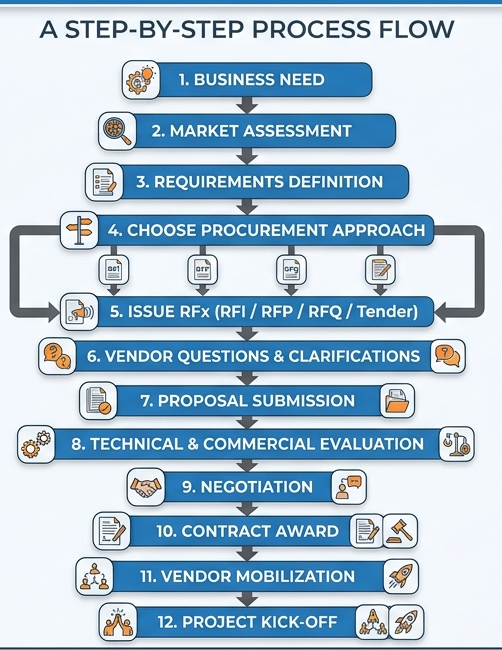 This lifecycle applies to most enterprise technology procurements, although individual organisations may tailor certain governance activities to their internal policies
1. Business Need
Every procurement should begin with a clearly defined business problem—not with a preferred vendor or technology.
Typical questions include:
- What problem are we solving?
- Why is procurement necessary?
- What business outcome are we trying to achieve?
- Who are the stakeholders?
A weak business case often leads to weak procurement decisions.
2. Market Assessment
Before writing requirements, organisations should understand what's available in the market.
Activities may include:
- industry research
- analyst reports
- vendor capability reviews
- product demonstrations
- preliminary discussions
This phase reduces the risk of requesting unrealistic or outdated solutions.
3. Requirements Definition
This is arguably the most important phase.
Requirements should clearly define:
- business objectives
- functional requirements
- non-functional requirements
- scope
- deliverables
- assumptions
- exclusions
- acceptance criteria
Poor requirements are one of the biggest causes of change requests later in the project.
4. Choose the Right Procurement Approach
Not every procurement requires an RFP.
Depending on the objective, organisations may issue:
- RFI – to understand market capabilities
- RFP – to evaluate competing solutions
- RFQ – when requirements are fixed, and pricing is the primary differentiator
Choosing the wrong procurement method can significantly increase procurement time and reduce proposal quality.
5. Issue the RFx
The procurement documents are formally released to invited vendors or the public market.
Typical contents include:
- scope
- requirements
- evaluation criteria
- commercial terms
- submission instructions
- timelines
At this stage, clarity is more valuable than volume.
6. Vendor Questions & Clarifications
Vendors rarely understand every requirement on the first read.
Organisations usually conduct a clarification process to:
- answer questions consistently
- remove ambiguities
- issue formal addenda if required
- ensure all bidders receive the same information
This promotes fairness and improves proposal quality.
7. Proposal Submission
Vendors submit their responses before the closing deadline.
Typical submissions include:
- technical proposal
- commercial proposal
- implementation methodology
- project plan
- proposed team
- assumptions
- compliance matrices
The quality of proposals often reflects the quality of the original RFx.
8. Technical & Commercial Evaluation
Evaluation should be structured, transparent, and based on predefined criteria.
Typical evaluation areas include:
- technical compliance
- implementation approach
- team capability
- governance
- commercial value
- project risks
Selecting the lowest-priced proposal is not always selecting the best value.
9. Negotiation
Before award, organisations may negotiate:
- commercial terms
- delivery timelines
- resource commitments
- contractual clauses
- assumptions
- support arrangements
Successful negotiations reduce uncertainty before delivery begins.
10. Contract Award
Once approvals are complete, the contract is executed.
At this stage:
- purchase orders are issued
- governance formally begins
- contractual obligations become effective
However, procurement is not yet complete.
11. Vendor Mobilisation
Many projects fail because organisations treat contract signing as the finish line.
Vendor mobilisation typically includes:
- onboarding project teams
- governance setup
- access requests
- environment preparation
- project charter
- communication plans
- risk workshops
- kickoff preparation
Strong mobilisation creates a smoother transition into delivery.
12. Project Kick-off
The kick-off meeting officially launches project delivery.
The focus shifts from procurement to execution through:
- team introductions
- governance confirmation
- delivery approach
- milestones
- risks
- communication cadence
- immediate next steps
The procurement lifecycle ends here, and the delivery lifecycle begins.
Comments
No comments yet — be the first to share your thoughts.
Leave a Reply